Oligonucleotides

Oligonucleotide Purification with MCSGP: Higher Yield, Fewer IPCs

In AIEX or IP-RP modes. A continuous twin-column process that recovers full-length ASOs, siRNA & GalNAc conjugates batch chromatography discards—fewer side-fraction losses, fewer in-process controls.


Published case results: +50% yield (60→90%+) on 20-mer | +38.8 pp yield (52.7→91.5%) on GalNAc conjugate | +13 pp yield (80→93%) on conjugated siRNA AIEX


Sources: YMC ChromaCon Oligo Application Note; Weldon et al., J. Chromatogr. A 2022; Weldon et al., Org. Process Res. Dev. 2025

HPLC Purification of Oligonucleotides: AIEX and RP

HPLC purification of oligonucleotides can use anion exchange (AIEX), ion-pair reversed-phase (IP-RP), or reversed-phase (RP) chromatography to separate full-length product from closely related synthesis impurities. In conventional batch purification, narrow product collection windows can protect purity but leave valuable full-length material in side-fractions that may require re-chromatography.


MCSGP addresses this limitation by continuously recycling impure side-fractions between two columns. The process uses the same stationary phases, buffers, and solvents as the existing batch method, allowing established oligonucleotide chromatography conditions to serve as the starting point for continuous process development.


The Oligonucleotide Purification Bottleneck in Batch HPLC

Oligonucleotide therapeutics are surging — with 24 FDA-approved drugs, 200+ candidates in clinical trials, and blockbuster siRNAs driving demand to multi-kilogram scales. Purification by anion exchange (AIEX) or ion-pair reversed-phase (IP-RP) chromatography is the critical downstream bottleneck.

Batch chromatography forces a painful trade-off: high purity or high yield — not both. Oligonucleotide crude feeds contain hundreds of closely related impurities — N-1 shortmers, N+1 longmers, phosphodiester (PO) failures, depurination products, and phosphorothioate diastereomers — many differing by as little as 1 Da in a 7,000+ Da molecule. Achieving target purity requires a narrow center-cut, discarding valuable full-length product in side-fractions. Recovering that product means costly re-chromatography — with all the associated solvent, buffer, and QC burden.

For high-volume APIs demanded by cholesterol-lowering siRNAs, hepatitis B ASOs, and GalNAc-conjugated therapies, this inefficiency is unsustainable.

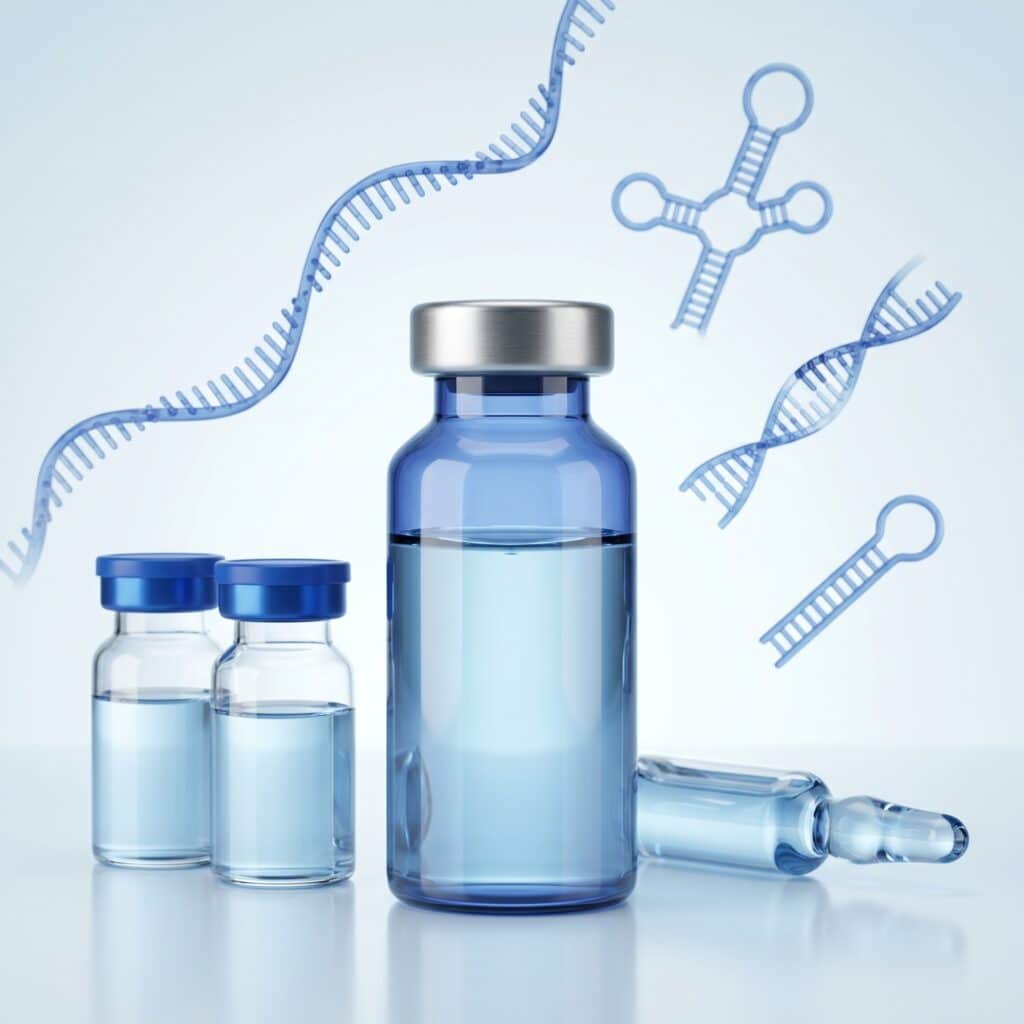
Oligonucleotide purification — illustration

The Solution: MCSGP with AutoPeak® for Oligonucleotide Purification

MCSGP (Multi-column Countercurrent Solvent Gradient Purification) eliminates the purity-yield trade-off in oligonucleotide chromatography. Two identical columns continuously recycle impure side-fractions — recovering full-length oligonucleotide product that batch processes discard. It uses the same AIEX, IP-RP, and RP resins, buffers, and solvents as your existing batch oligonucleotide method.

AutoPeak® dynamic process control monitors oligonucleotide elution profiles in real-time via UV and conductivity, automatically adjusting collection windows to maintain consistent output quality — enabling robust, unattended 24/7 oligonucleotide purification. Without AutoPeak® control, studies have shown yields can drop to as low as 20% under process variability — AutoPeak® eliminates this risk.

Same chemistry. Better results. MCSGP works with the AIEX, IP-RP, and RP stationary phases and mobile phases already used in your oligonucleotide batch process — your existing resin and eluent conditions are the starting point for MCSGP development. No change to your chromatographic chemistry is needed.

Learn About MCSGP + AutoPeak®
Continuous chromatography - MCSGP — illustration

Proven Results: MCSGP vs. Batch – Oligonucleotide Purification

+13–74%

Yield Increase

90%+

Typical MCSGP Yield

87% ↑

Throughput Increase

Zero

Re-chromatography Runs

42.5% ↓

Synthesis Scale Reduction

Productivity Gain

HPLC Purification of Oligonucleotides: Batch vs. MCSGP

Parameter Batch Oligonucleotide Chromatography MCSGP with AutoPeak®
Purity-Yield Trade-off Inherent — narrow cuts sacrifice yield Eliminated — high purity AND yield simultaneously
Product Yield 50–80% 90–95% (+13–74% absolute)
Re-chromatography Required for side-fractions Eliminated — internal recycling
Buffer/Solvent Consumption High Comparable or reduced per gram product
IPC/QC Burden Testing every side-fraction, every batch Massively reduced — one sample per MCSGP cycle
Throughput Limited by re-chromatography cycles Up to 87% higher (continuous 24/7)
Process Control Manual monitoring Automated (AutoPeak® UV-based PAT)
Robustness Sensitive to drift and crude feed variability AutoPeak® dynamically compensates
Operator Requirement Requires supervision Designed for unsupervised operation
Upstream Synthesis Impact Fixed synthesis scale Higher yield enables up to 42.5% synthesis downscaling
Stationary Phase / Eluents Standard AIEX / IP-RP / RP Same — no change required

The Contichrom® Platform: From Oligonucleotide Development to Production

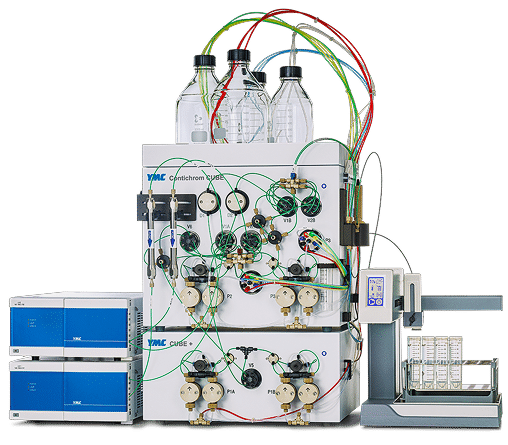
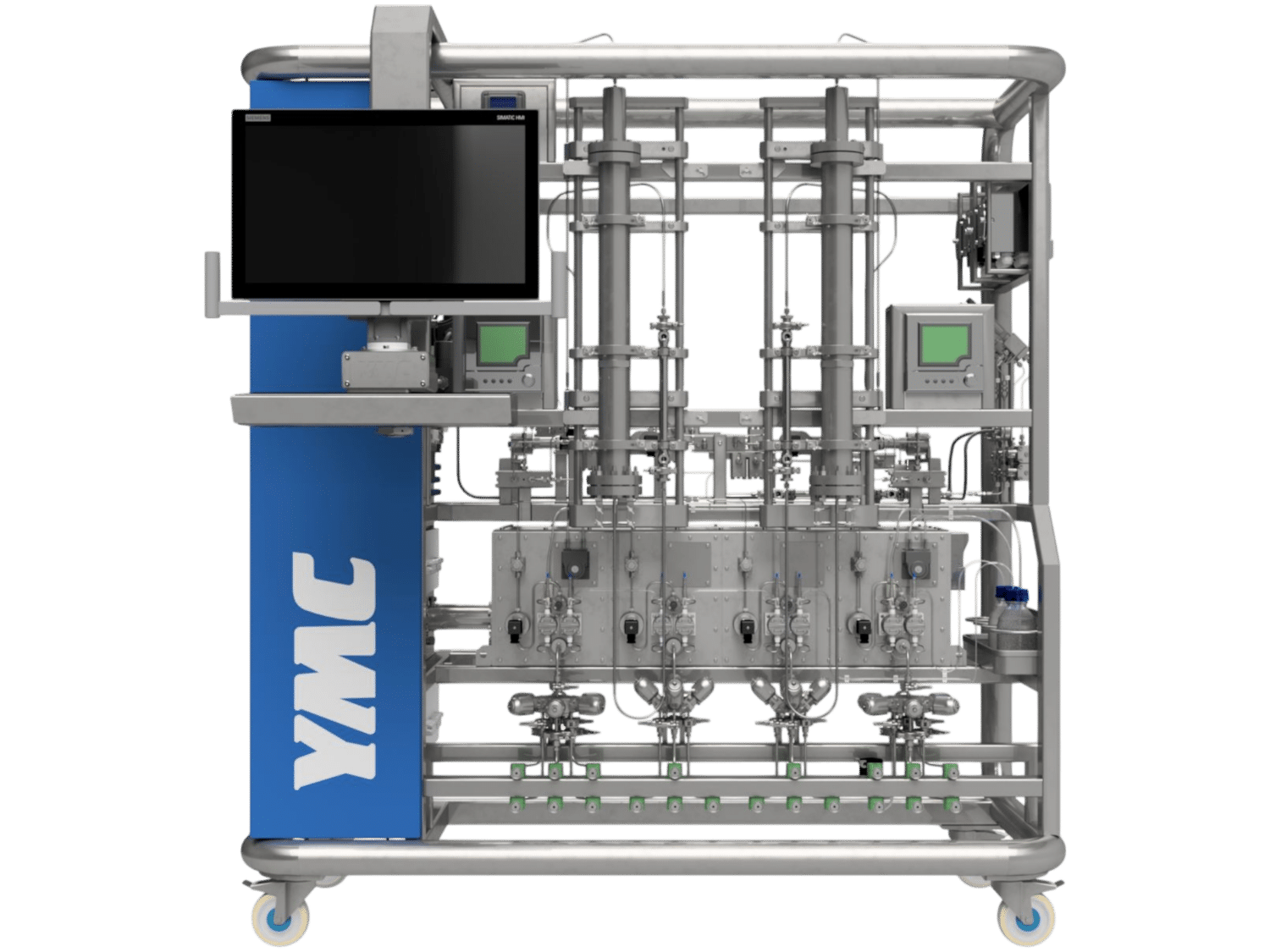
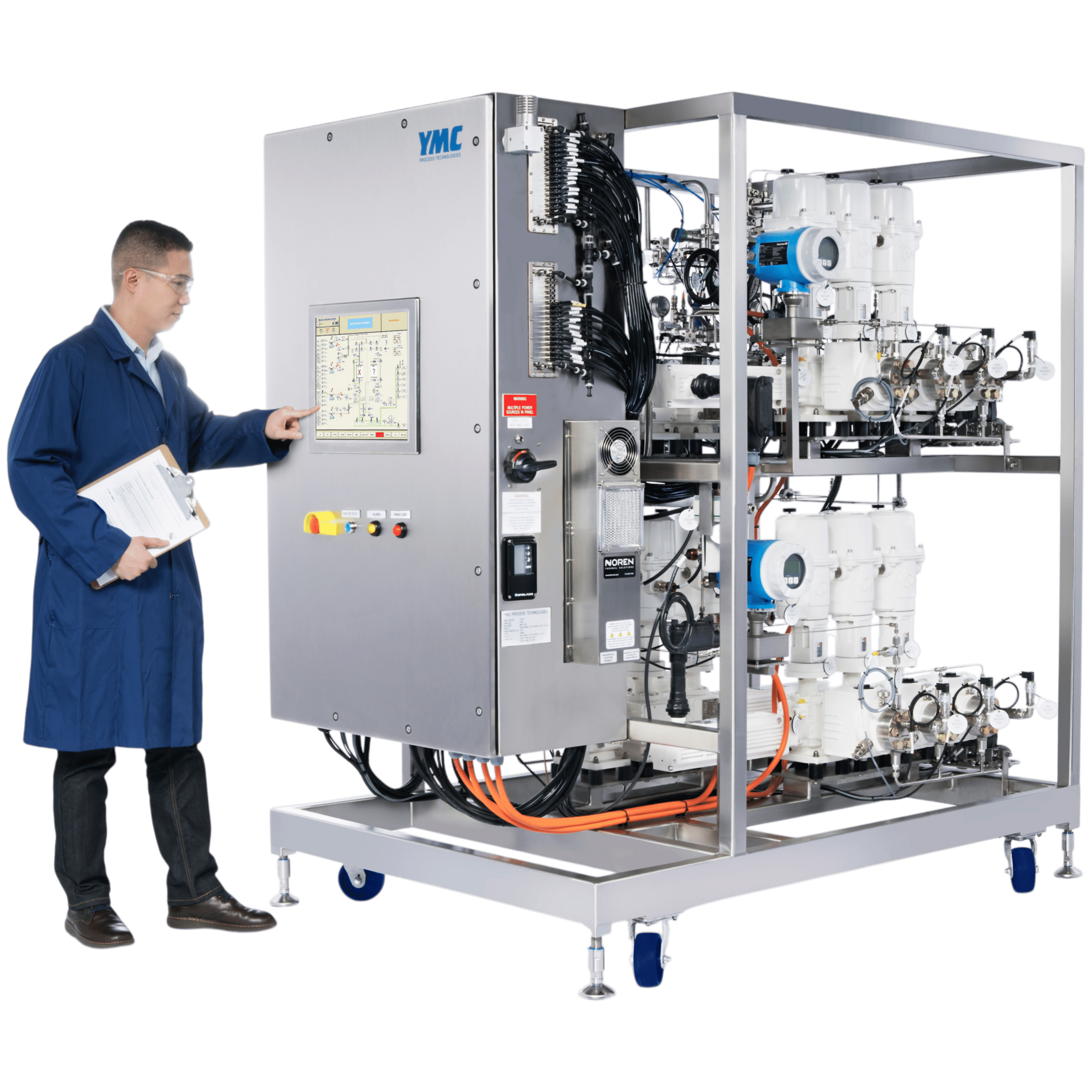
All Contichrom® systems support twin-column continuous chromatography with AIEX, IP-RP, and RP resins used in oligonucleotide purification (particle sizes ≥10 µm). Methods scale predictably from CUBE → PILOT 300X → TWIN HPLC.

Oligonucleotide Purification Applications

Antisense Oligonucleotides (ASOs)

ASOs with phosphorothioate (PS) backbones generate complex diastereomer mixtures and broad chromatographic peaks that make batch purification especially challenging. MCSGP continuously recovers full-length product from overlapping PS impurity shoulders — delivering yields of 90%+ at target purity with AIEX or IP-RP chromatography.


Small Interfering RNAs (siRNAs)

siRNA sense and antisense strands require high-purity individual strand purification before duplex annealing. Published MCSGP data on a conjugated siRNA sense strand showed yield improvement from 80% to 93% with AIEX, with 87% higher throughput — critical for the multi-kilogram scales demanded by cholesterol-lowering and hepatitis therapies.


GalNAc-Conjugated Oligonucleotides

GalNAc conjugation enables liver-targeted delivery and is used in the latest FDA-approved oligonucleotide therapies. The bulky GalNAc cluster adds purification complexity. MCSGP with RP-HPLC demonstrated +73.6% relative yield improvement for a GalNAc-DNA-LNA gapmer, enabling 42.5% synthesis downscaling.

Other Oligonucleotide Purification Methods Options

Multi-Step Oligonucleotide Purification (AIEX + IP-RP / RP-AEX)

Combine orthogonal oligonucleotide purification steps — AIEX for charge-based separation and IP-RP for hydrophobicity-based separation — in a single automated 2D chromatography workflow. RP-AEX sequence eliminates the need for in-line dilution and produces the sodium counterion form required for formulation.


Oligonucleotide Impurity Isolation & Characterization (N-Rich)

ICH-required oligonucleotide impurity characterization (N-1, N+1, PO failures, depurination products) typically takes weeks of repetitive analytical runs. N-Rich automated on-column enrichment isolates milligram quantities of target oligonucleotide impurities up to 80× faster.

Getting Started with MCSGP for Oligonucleotide Purification

See the Contichrom® platform in action before you commit, assess MCSGP suitability computationally or experimentally using your own sequence and resin, develop your continuous method at lab scale on a Contichrom CUBE, then scale to GMP production on the TWIN HPLC — the same platform behind Bachem’s first GMP-validated continuous oligonucleotide process (2023).

See It First — Free Demo or Webinar

Not yet familiar with the Contichrom® platform? Start here. YMC ChromaCon offers no-charge demonstrations and introductory webinars tailored to your team.

  • On-site in Zurich (half day, 2–4 hours): see the CUBE in person, run ChromIQ® live, discuss your oligonucleotide purification challenge with YMC ChromaCon application scientists
  • Remote webinar (1–3 hours): interactive live session covering MCSGP, N-Rich, ChromIQ® software, and the full Contichrom® ecosystem
  • Sessions cover MCSGP process design for AEX and IP-RP separations, the ChromIQ® MCSGP Wizard, and scale-up to TWIN HPLC

→ Request a free demo or introductory webinar

Modeling Assessment for Oligonucleotides

Predict how MCSGP will perform on your oligonucleotide molecule and resin before running a single continuous experiment. YMC ChromaCon builds a calibrated mechanistic model from your existing batch data.

  • Submit linear gradient batch chromatography runs with fraction collection and analytical purity data (AEX or IP-RP; from any HPLC or FPLC system — no Contichrom® required)
  • YMC ChromaCon calibrates and validates the model, simulates MCSGP operating points, and delivers a predicted batch vs. MCSGP performance comparison (yield, purity, productivity) with initial scale-up parameters
  • AutoPeak® dynamic control impact is included in the simulation
  • Typical timeline: 3–5 weeks from receipt of data; no material shipment required

→ MCSGP Process Modeling Service

Experimental Feasibility Study — Your Oligo, Your Resin

Your oligonucleotide is purified on YMC ChromaCon’s Contichrom® platform at our facility in Zurich. We reproduce your batch AEX or IP-RP method as a benchmark and run ≥ 3 MCSGP experiments side-by-side.

  • Ship starting material to Zurich — typically ≥ 20× a single preparative batch run, scaled to 1 cm i.D. columns
  • We reproduce your analytical HPLC method, establish the batch benchmark, and run MCSGP experiments using your resin and buffer system
  • Deliverable: side-by-side batch vs. MCSGP comparison with real chromatographic data from your sequence and resin, plus fractions for your independent purity verification
  • Typical timeline: 4–6 weeks after receipt of starting material and purchase order

→ YMC ChromaCon Feasibility Studies

Develop at Lab Scale — Rent or Purchase a CUBE

MCSGP method development is performed on the Contichrom CUBE using your existing AEX or IP-RP resin and buffer system. Available for rental or purchase.

  • ChromIQ® MCSGP Wizard designs the initial MCSGP operating point from a single batch chromatogram — method setup completed in as little as 15 minutes
  • Your current batch gradient conditions are the starting point — no new resin or method development required
  • AutoPeak® dynamic process control adjusts collection windows in real-time based on the UV elution profile, compensating for feed variability and column aging
  • The CUBE supports both MCSGP and N-Rich on the same platform

→ Contichrom CUBE Rental Program

→ Purchase a Contichrom CUBE

Scale to GMP Production — PILOT 300X or TWIN HPLC

The MCSGP method developed on the CUBE transfers directly to larger Contichrom systems for pilot and manufacturing-scale production. YMC ChromaCon provides scale-up consulting and GMP documentation support.

  • PILOT 300X (up to 300 mL/min, 100 bar, ATEX Zone 2) for pilot-scale and clinical supply batches
  • TWIN HPLC for GMP production — the same platform used for Bachem’s first GMP-validated continuous oligonucleotide purification process (2023)
  • Scale-up is driven by column diameter — bed height, gradient conditions, and AutoPeak® control logic are preserved across scales
  • Four TWIN HPLC system sizes cover lab through full production scale
  • GMP documentation support (IQ/OQ/PQ) and scale-up consulting available

→ Scale-Up Consulting and Training

Ready to Transform Your Oligonucleotide Purification?

Unlock This Resource

Fill in your details to receive the full content straight to your inbox.

Frequently Asked Questions About Oligonucleotide Purification